
BASEMENT WATERPROOFING · TIFFIN, OH
Exterior Waterproofing & French Drains in Tiffin, OH
Handling moisture from the outside is the definitive way to block infiltration before it ever penetrates your foundation walls. The process requires excavating down to the base footing, installing a dedicated barrier membrane, laying slotted piping surrounded by clean stone, and refilling the trench with materials that promote proper drainage. While this stands as the highest-priced service in our industry, it delivers lasting results, and for older river communities like Tiffin where varying groundwater elevations press against older masonry, it can be the sole effective remedy. However, this intensive work is frequently proposed when less drastic measures would suffice, and we will honestly inform you if a simpler fix is appropriate. Call (419) 406-4560 to schedule a complimentary site evaluation.
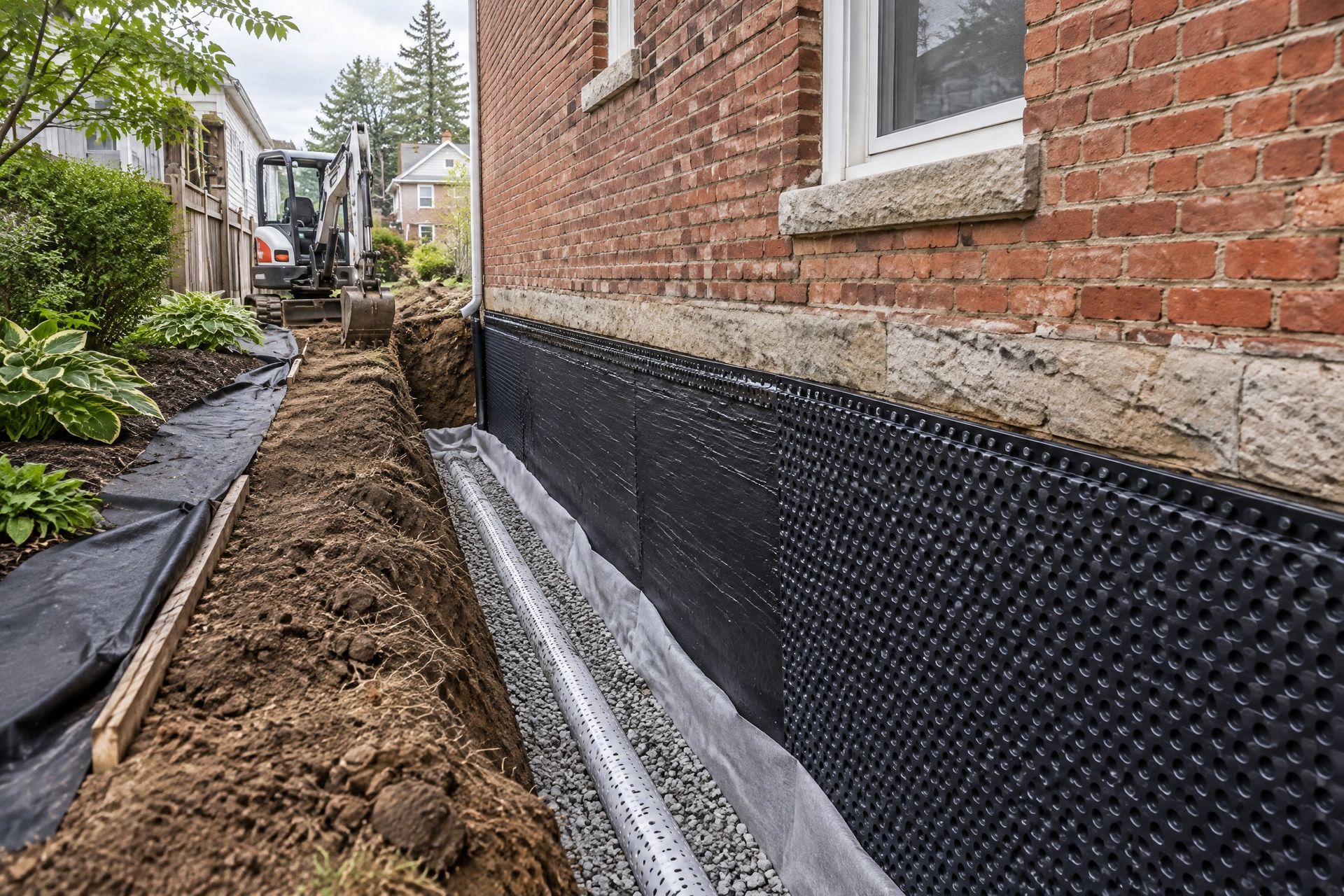
What exterior waterproofing involves
The work begins with digging a trench alongside the structure until the bottom footing is reached, and the overall depth heavily influences the final price. Once the exterior face is completely bare, we wash the surface, patch any deteriorated masonry joints, and roll on a heavy-duty waterproofing membrane rather than a basic damp-proofing layer. Understanding this difference is crucial: basic damp-proofing merely blocks vapor transmission, whereas a true membrane creates an unbroken shield against active liquid pressure. Down at the footing level, we install slotted drainage tubing covered by clean aggregate and a protective fabric sleeve, angling it toward a safe discharge point so intruding moisture is safely diverted away.
How the trench is refilled ultimately determines the long-term success of the installation. Returning the excavated dirt directly against the fresh membrane simply invites the original issues back, trapping moisture and allowing the soil to expand against older block or brick walls. Instead, we fill the bottom section with porous stone to ensure descending moisture reaches the drain pipe quickly rather than pushing laterally into the masonry, topping it off with soil pitched away from the structure. We also route downspouts well beyond the disturbed earth and connect any window well drains into the main line. Neglecting these finishing details turns a premium investment into a failing system.
When exterior waterproofing is the right answer
These specific conditions indicate that internal management systems alone will fall short.
- Active streams of moisture flowing down the interior masonry face during heavy storms
- Older brick or block foundations that constantly weep through degraded mortar seams
- Exterior soil levels that sit higher than the basement floor, making surface regrading impossible
- Foundation walls exhibiting inward bowing where reducing outside soil weight is necessary
- Plans to fully finish the lower level requiring absolute moisture prevention rather than management
- Moisture continuing to breach the upper wall sections despite a functioning internal drain system
Get Your Free Quote
Why outside water reaches Tiffin foundations
Situated along the Sandusky River, Tiffin experiences fluctuating groundwater elevations that often stay high following significant precipitation or seasonal changes. When heavy storms hit, excess rainfall that cannot penetrate the earth flows across the yard seeking the deepest available depression. Because the earth immediately surrounding older homes has inevitably compacted over the decades, the foundation perimeter becomes the collection zone. Once moisture accumulates in this adjacent soil, it lingers there, keeping the ground thoroughly soaked. Mixed masonry or vintage block construction subjected to these conditions faces relentless hydrostatic pushing, with the mortar lines serving as the primary failure points.
Historical data clearly illustrates the consequences of fully saturated earth in our area. The Sandusky River famously reached a crest of 20.4 feet back in March 1913, and modern river levels frequently approach or surpass minor flood thresholds. The crucial factor for your property is the chain of events: prolonged rainfall fills the earth, pushing the water table upward and eliminating any capacity for new drainage. If a residence remains dry for decades and suddenly experiences intrusion, the structure itself rarely failed. Instead, the surrounding earth and local water table simply exceeded their maximum capacity.
What affects the cost of exterior waterproofing in Tiffin
The required digging depth and site accessibility dictate the final investment. Detailed pricing ranges are available on our cost page.
- Total distance down to the foundation base, since deeper trenches require moving significantly more earth
- The total length of the required trenching, whether addressing a single wall or the entire house
- Clearance for heavy machinery, as tight property lines or fencing may necessitate manual labor
- Surface obstacles blocking the path, including porches, driveways, climate control units, or large trees
- Buried utility lines, requiring careful navigation around water, gas, or sewer connections
- Final site recovery, involving the replacement of removed plants, concrete walkways, or paved surfaces
Interior or exterior — which one you actually need
The reality is that these two approaches serve entirely distinct purposes rather than acting as interchangeable options. Internal systems are designed to handle moisture rising from beneath the slab, a common scenario in Tiffin when the seasonal water table presses against the basement floor. Digging a trench outside cannot alter regional groundwater levels, meaning that if moisture is bubbling up through the concrete or the lower cove joint, an exterior membrane will not solve the core issue while costing substantially more. Any contractor recommending outside excavation for floor-level seepage without clear justification is pushing a larger sale instead of the correct solution.
Outside intervention becomes the proper choice when moisture penetrates above the floor line: streaming down the interior face, seeping through elevated mortar cracks, or persisting even after surface drainage improvements. The situation gets particularly tricky in Tiffin when an aging masonry wall faces moisture intrusion from both the top and bottom simultaneously. In certain cases, the most effective strategy involves combining both methods, perhaps utilizing an exterior membrane on the uphill slope while relying on internal drains for the remaining perimeter. Such determinations require a thorough physical inspection rather than a quick phone consultation.
Our step-by-step process
STEP 1
Thorough site evaluation to verify that moisture is penetrating from the upper wall rather than seeping upward
STEP 2
Detailed proposal providing a firm price for the digging, barrier application, piping, refilling, and final cleanup
STEP 3
Coordination of utility marking and confirmation of allowable discharge locations and necessary paperwork before ground is broken
STEP 4
Careful digging down to the base footing, placing the removed earth where it cannot slide back into the hole
STEP 5
Surface preparation and masonry patching, followed by the installation of a seamless protective membrane
STEP 6
Placement of slotted drainage lines surrounded by washed stone and protective fabric, pitched toward an appropriate exit
STEP 7
Refilling the trench base with porous aggregate, topping with sloped earth, and routing gutter drains away from the zone
STEP 8
Final review, replacement of disturbed surface features, and a comprehensive explanation of the completed system
Timeline and what to expect
Expect the project to span three to five days for partial installations, extending further for complete perimeters. This represents our most intrusive procedure, and homeowners should anticipate an exposed trench, large machinery on site, and temporary landscape disruption. Furthermore, this specific service is heavily reliant on favorable weather conditions. Heavy precipitation and open trenches are a disastrous combination, causing cave-ins and preventing proper membrane adhesion to the masonry. We monitor meteorological forecasts closely and will postpone commencement rather than risk exposing the foundation to an incoming storm. Because the barrier requires a dry surface to bond correctly, extended rainy periods will inevitably delay the schedule.
GOOD TO KNOW
FAQs
Is exterior waterproofing worth the extra cost?
When prescribed correctly, absolutely, as it tackles the source of the intrusion and operates without relying on mechanical pumps. However, if misdiagnosed, it becomes a costly endeavor that fails to resolve the underlying issue, a detail frequently omitted during aggressive sales pitches. Should your moisture originate from beneath the slab, digging up the yard provides zero benefit regardless of the investment. Securing an accurate initial assessment makes the financial decision straightforward.
We will disturb it, and we would rather be honest about that than surprise you. Spoil goes on plywood or sheeting rather than straight onto grass, we keep the working corridor as narrow as safety allows, and we reinstate the grade and reseed at the end. But a trench along one wall of your house is visible for a season afterward. Mature planting in the way generally cannot be saved, and we will tell you which specific plants are at risk before we start.
Will you have to dig up my landscaping and driveway?
Anything situated directly above the proposed trench line must be temporarily or permanently removed. Many bushes can be carefully extracted and preserved if they are robust and the season permits. Large trees situated near the foundation pose significant challenges, as severing primary roots threatens their stability, which sometimes prevents exterior trenching on that specific side. Any concrete walkways, wooden decks, or paved surfaces crossing the dig path require demolition and rebuilding, and we include these restoration costs in our initial proposal to prevent surprises.
What is the difference between waterproofing and damp-proofing?
Damp-proofing consists of a thin spray intended to block moisture vapor from passing through the wall. Waterproofing utilizes a thick, continuous membrane engineered to withstand active liquid pressure. The vast majority of residential construction only included basic damp-proofing, which quickly proves insufficient when saturated earth presses against older brick or block. If an estimate specifies damp-proofing instead of waterproofing, you should seek clarification, as the lower price tag indicates a substantially less capable product.
Can this be done in winter?
While technically possible, the harsh Ohio climate creates severe complications. Solidified earth resists clean excavation, membrane products require specific ambient temperatures to cure properly, and trenches exposed to freezing and thawing cycles remain dangerously unstable. The optimal timeframe for this procedure runs from late spring through early autumn. If you experience severe intrusion during February, an internal system often presents the smartest choice, as it ignores external weather conditions and provides immediate relief while awaiting better weather for any necessary outside work.
Do you need to excavate the whole perimeter?
In most situations, no, and a truthful evaluation can prevent unnecessary expenditures. Moisture typically breaches the specific wall facing an uphill slope or suffering from poor surface drainage, and addressing that single side frequently resolves the entire situation. We examine the complete exterior, evaluate the soil grading, and recommend action only where justified. While treating the entire footprint is occasionally required, it should be the result of careful analysis rather than a standard assumption.
Find out whether you need to dig at all
Receive a complimentary site evaluation and a firm written proposal. The majority of residents inquiring about outside excavation actually require a less intensive solution, and we prefer to provide that honest assessment.